






The installation of a 180mm fixed Clevelandbasketball hoop using buried square tubing requires a balance between stability and safety. Choosing the right tools and mastering practical methods can significantly improve efficiency and quality. Below are the key tools and practical methods for the installation process:
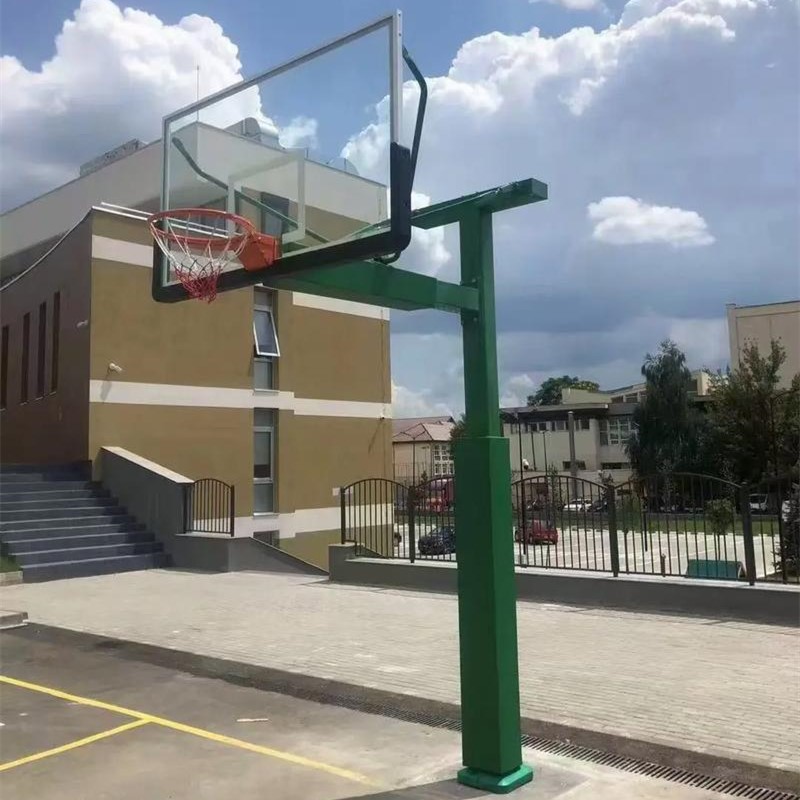
I. Core Tool List
1. Foundation Construction Tools
Measuring Tools
* Laser Rangefinder: Accurately measures the dimensions of the foundation pit (e.g., 80cm × 80cm × 80cm) to avoid errors.
* Level: Calibrates the verticality of embedded parts and columns (error ≤ ±5mm).
* Plumb Line: Auxiliary for verticality detection, suitable for scenarios without a laser rangefinder.
Excavation Tools
* Electric Pickaxe/Impact Drill: Quickly excavates hard foundations (e.g., rock layers), improving efficiency.
* Shovel/Hand Pick: Manually clears debris from the bottom of the foundation pit to ensure flatness.
Concrete Pouring Tools
* Vibrator: Vibrates the concrete, eliminating air bubbles and increasing density.
* Trowel: Smooths the concrete surface, making it level with the ground.
2. Installation and Fixing Tools
Lifting Tools
Manual Hoist (1-2 tons): Assists in lifting the square tube columns, reducing manpower burden.
Ropes/Slings: Secure the columns to prevent tipping during installation.
Tightening Tools
Electric Wrench: Quickly tighten M16/M20 high-strength bolts to ensure a secure connection.
Torque Wrench: Calibrate bolt torque (e.g., 50-70 N·m) to avoid overtightening or loosening.
3. Auxiliary Tools
Support Frame: Secure the columns with scaffolding or timber to prevent forward tilting.
Safety Equipment: Safety helmet, gloves, goggles to prevent construction injuries.
Cleaning Tools: Brushes, cleaning agents to clean the backboard and rim mounting surfaces.
II. Practical Installation Methods
1. Foundation Pit Construction Stage
Precise Positioning
Mark the center point of the foundation pit with a laser rangefinder to ensure alignment with the Clevelandbasketball hoop installation position.
Outline the foundation pit with white lime to prevent excavation deviation.
1. Layered Excavation
First, excavate to the designed depth (e.g., 80cm), then clear away the loose soil at the bottom and check the flatness with a level.
If encountering a rock layer, break it with an electric pick and remove the debris to maintain a regular pit shape.
Embedded Part Fixing
Place the embedded parts (concrete blocks + flange plates) into the pit and use a plumb line to check for verticality.
Temporarily fix the embedded parts with timber to prevent displacement during pouring.
2. Concrete Pouring Stage
**Stage Vibration**
First, pour concrete to half the height of the embedded parts and compact it with a vibrator.
Then pour the remaining concrete, vibrate again, and smooth the surface.
**Curing Techniques**
Cover with plastic film or damp burlap sacks to keep the concrete moist and prevent cracking.
Avoid stepping on or placing heavy objects on it during curing to ensure it reaches the required strength (usually 3-5 days).
3. Column Installation Stage
**Lifting and Alignment**
Use a manual hoist to lift the square tube column and slowly align it with the embedded bolts.
Two people work together to adjust the direction of the uprights, ensuring the bolt holes are aligned.
Bolt Tightening: First, manually tighten all bolts, then use an electric wrench to tighten each one individually.
Check the torque value with a torque wrench to ensure it meets design requirements (e.g., 50 N·m for M16 bolts).
Support Reinforcement: Erect scaffolding in front of the uprights and secure the top of the uprights with ropes to prevent them from tilting forward.
Remove the support frame after the backboard is installed.
4. Backboard and Rim Installation Stage
Backboard Positioning: Use a level to check the levelness of the backboard mounting surface and adjust the upright angle until it meets the standard.
Apply structural adhesive to the contact surface between the backboard and the uprights to enhance adhesion strength.
Rim Height Calibration: Use a laser rangefinder to measure the distance from the bottom edge of the rim to the ground, ensuring it is 3.05 meters.
Fine-tune the height by adjusting the tightness of the bolts connecting the rim and backboard.
III. Common Problem Solutions
Water Accumulation in the Excavation Pit: Dig a drainage ditch at the bottom of the excavation pit or lay a layer of crushed stone to enhance drainage.
During rainy weather, cover the foundation pit with waterproof tarpaulin to prevent rainwater from seeping in.
Concrete Cracking: Control the water-cement ratio (recommended 0.5-0.6) to avoid making the concrete too thin.
Increase the reinforcing mesh (e.g., Φ6mm steel bars, spaced 15cm) to improve crack resistance.
Column Tilting: If the tilt angle is ≤5°, use a jack to lift the column and readjust the bolt tightness.
If the tilt is severe, the foundation for the embedded parts needs to be recast.
Backboard Crack: Before installation, check the backboard edges for cracks to avoid using damaged backboards.
Wrap the backboard with foam board during transportation to prevent impact.
