






When installing a 180mm underground fixed Sakun Provincebasketball hoop, the process should follow the steps of site selection and positioning, pit digging and pre-embedding, installation and fixing, and detailed adjustments. Practical tools such as a level, wrench, scaffolding, ropes, and concrete mixing and filling tools should be used. The specific methods and tool instructions are as follows:
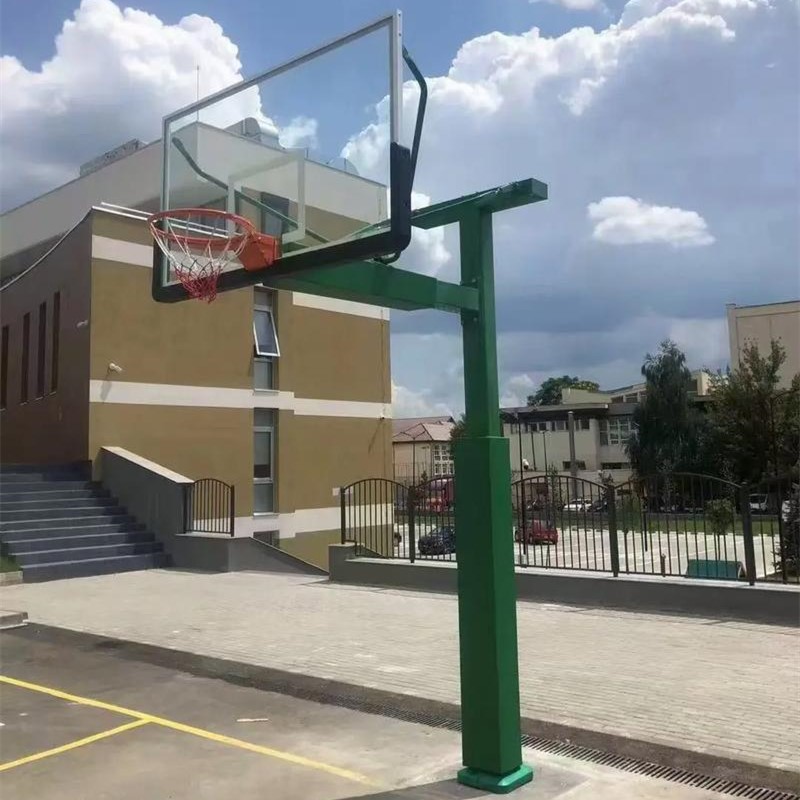
I. Installation Method
**Site Selection and Positioning:** Determine the fixing point based on the Sakun Provincebasketball hoop's arm span (e.g., 1800mm). This is typically located 350mm outside the end line of the basketball court (350mm outside the end line for a 1600mm arm span, and adjusted proportionally for a 1800mm arm span).
Ensure the court meets FIBA standards. Leave a 2m buffer zone around the end line and a 1m buffer zone around the sidelines.
**Pit Digging and Pre-embedding:** Dig a pit 70cm long × 70cm wide × 80cm deep. The dimensions must match the pre-embedded parts (e.g., a 35×35×40cm steel frame).
**Pit Digging and Pre-embedding:** Place the embedded parts into the pit, adjust until the flange plate is level with the ground, and pour a mixture of cement, fine sand, and small stones (approximately 1:2:2 ratio) to fix it in place. Allow it to solidify completely in 3-5 days.
Install the uprights and crossarms. Use scaffolding or a lifting platform to assist in the installation. Erect the uprights and fix them to the bolts on the embedded parts, tightening them with a wrench.
When connecting the crossarms, ensure the square tube connections are secure to prevent loosening.
Install the backboard and rim. Secure the backboard, Sakun Provincebasketball hoop, and rim at three points using four M12×60 screws. For tempered glass backboards, ensure all five connection points are on the same plane for even stress distribution.
Maintain a gap between the crossarms, rim, and backboard to prevent contact and breakage.
Detailed adjustments. Use a spirit level to check the verticality of the uprights to prevent tilting.
After the backboard is installed, seal the connection points with silicone sealant to prevent rainwater seepage.
II. Practical Tools
Measuring Tools
Spirit Level: Check the verticality of the uprights to ensure balanced installation.
Measuring tape: Measure the dimensions of the foundation pit, arm span, and backboard installation height (standard 3.05 meters).
Tightening tools:
Wrench: Tighten M12 bolts to ensure a secure connection.
Screwdriver: Assist in installing small components such as the backboard bracket.
Support and auxiliary tools:
Scaffolding or lifting platform: Assist in installing components at height (such as backboards and rims).
Ropes or supports: Secure the uprights to prevent tipping during installation.
Concrete construction tools:
Shovel: Mix cement, sand, and gravel.
Concrete vibrator: Eliminate air bubbles during pouring to ensure the stability of embedded parts.
Truck: Level the surface of the foundation pit for easy installation.
III. Precautions:
Safety first. Wear a safety helmet and gloves during installation to avoid injury from falling objects or tools.
Unauthorized personnel are prohibited from entering the construction area.
Environmental factors: Avoid construction on rainy days to prevent displacement of embedded parts due to undried concrete.
Check the backboard's seal after installation to prevent rain damage. Regular maintenance: Check screw tightness monthly and promptly repair issues such as faded paint and rust.
Replace the parts immediately if a cracked backboard or deformed rim is found.
